
Intranet: Definition and Features

.svg)
- An intranet is a closed network specific to one organization: only authorized people can reach it, unlike the internet, and it is not open to customers or partners, unlike the extranet.
- Born in the 90s as a single page of internal information, it has become in thirty years a cloud workspace, reachable from anywhere and from mobile.
- Its main features: internal documents, news, surveys, directory, org chart, knowledge base, shared calendar and search engine. Its secondary features: email, chat, videoconferencing, project management, HR area.
- According to the Arctus 2023 study (377 companies), one intranet in two offers a collaborative workspace, 46% electronic document management, 40% co-editing and 37% instant messaging.
- It is deployed first to keep internal information flowing (the primary digital challenge for 69% of the companies surveyed), then to capture knowledge and improve operational efficiency (59% each).
- The installed base has grown younger: two companies out of three run an intranet that is three years old or less, against 20% in 2009.
If you work in a large company or a large group, you are probably familiar with the term intranet. Since the 90s, the intranet has earned a central place in organizations. It has of course been modernized along the way, following trends and technological innovations.
It has become a social and collaborative tool. According to the 2023 study by the Observatory of the Intranet and Digital Communication, run by Arctus among 377 companies, one intranet in two offers a collaborative workspace, 46% include electronic document management, 40% allow co-editing and 37% have instant messaging.

1) Definition
The early intranet
An intranet is a local network specific to one organization (a company, a university, an institution) that lets employees access internal information and communicate with each other. It works like a website: it requires a web server and the associated protocols. Unlike the internet, which is open to everyone, an intranet stays closed: only the people the organization authorizes can reach it. It should not be confused with the extranet either, which is intended for external use: a network made available to customers, suppliers and partners.
Initially, the intranet was only accessible from workstations connected to the local network. To connect, users needed a login and a password. In its early days, it served internal communication, with a simplified interface, often a single page gathering a lot of information.
Over the years, this internal network has evolved, integrating more and more features and offering interfaces that are easier and more pleasant to use.
The intranet today
In thirty years of existence, the intranet has been transformed, enriched and modernized. It has gradually incorporated technologies (business chat, videoconferencing, news feeds) until it became a real workspace.
Companies now use the "cloud" intranet, which removes the limits of on-premise servers by letting authorized people connect from anywhere. Today’s intranet often comes with a search engine, a calendar, a mobile application and a whole set of tools that keep users effective even when they are on the go.
The installed base has also grown younger: according to the same Arctus study, two companies out of three run an intranet that is three years old or less, whereas in 2009 only 20% of intranets were under three years old.
Read also: [Arctus 2023 Study] What Is the Role of the Intranet in the Workplace?
2) Intranet features
An intranet makes the documents and information needed to run the company available to employees, while reducing the risk of data leaking outside. It centralizes information and provides permanent access to it.
As mentioned above, it is increasingly common, and this is a natural extension of the initial uses, to see collaborative work features integrated into intranets.
Main features:
- Access to internal documents (procedures, forms)
- Sharing of important internal news (replacing the internal newsletter)
- Internal surveys
- Employee directory
- Organizational chart
- Knowledge bases
- Shared calendar (gathering important internal events)
- Search engine to find documents and files easily
Secondary features:
- Chat
- Videoconferencing and audioconferencing
- Project management
- HR area (to book leave, submit expense reports)
| Feature | What it is for | What it usually replaces |
|---|---|---|
| FeatureNews feed | What it is forSharing internal information with everyone at the same time | What it usually replacesThe internal newsletter and company-wide emails |
| FeatureDocument library | What it is forGiving permanent access to procedures, forms and templates | What it usually replacesThe file server and email attachments |
| FeatureDirectory and org chart | What it is forKnowing who does what and who to contact | What it usually replacesThe printed staff directory and scattered contact lists |
| FeatureSearch engine | What it is forFinding a document or a piece of information without asking around | What it usually replacesFollow-up emails and word of mouth |
| FeatureSurveys | What it is forCollecting feedback from teams on a decision or a project | What it usually replacesQuestionnaires sent as attachments |
| FeatureHR area | What it is forBooking leave, submitting expense reports, tracking requests | What it usually replacesPaper forms and emails to the HR team |
3) Why set up an intranet?
An intranet is not deployed for the technology, but to solve specific organizational problems. The Arctus 2023 study sets out the priorities companies address with their internal digital platform.
- Keeping internal information flowing. Internal communication is seen as the primary digital challenge by 69% of the companies surveyed.
- Capturing and passing on knowledge. This comes next, cited by 59% of respondents, at the same level as operational efficiency.
- Building social bonds between employees. 59% of respondents see it as an opportunity of internal digital, ahead of engaging and retaining talent (36%) and supporting remote work (34%).
- Keeping sensitive documents inside. A closed space with access rights avoids files circulating as attachments outside the organization.
Read also: 5 Key Benefits of the Intranet and Email, Intranet, or Collaborative Platform: What Is the Difference?
4) What comes after the intranet?
As digital habits changed, the intranet went through major shifts and now brings many services to organizations and their employees. With the rise of the digital workplace, it will once again have to redefine its role and its contribution to the company community. Many software publishers have already repositioned themselves, starting with Talkspirit.
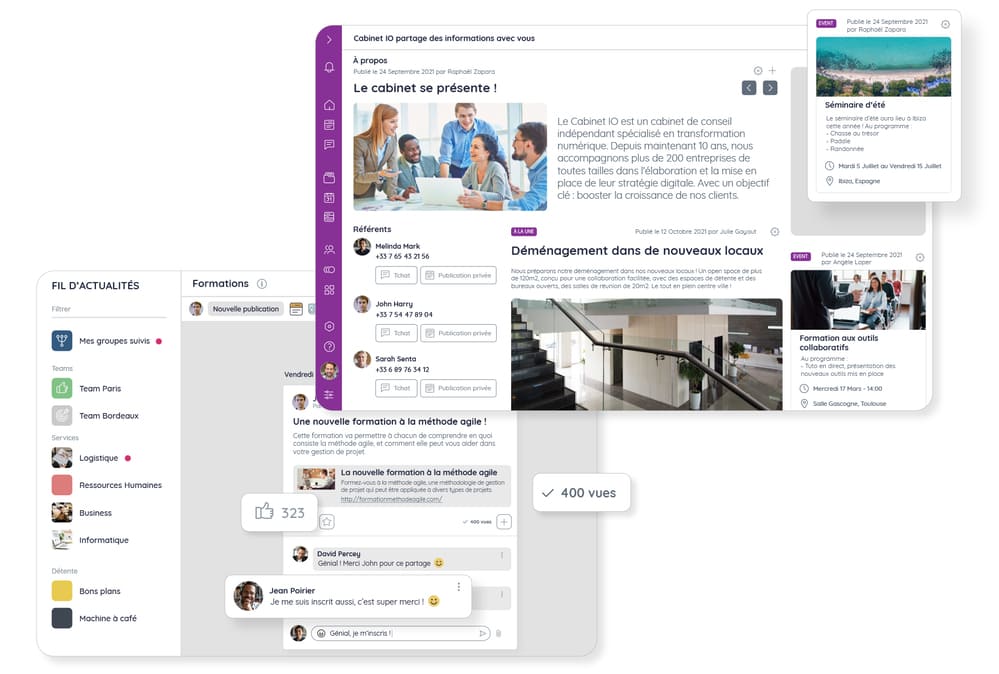
Discover the Talkspirit intranet
Read also: The 14 best intranet solutions
Going further: setting up your intranet
You want to set up an intranet but do not know where to start? Our dedicated article walks through the 8 steps to set up your intranet: identifying your needs, picking your solution, preparing your communication plan and securing adoption of the platform.
Read the 8 steps to set up your intranet
Our guides on governance, internal communication and organization design are gathered in our white paper library.
Do you have a project in mind? Contact us: the Talkspirit team will be happy to advise you and guide you through it.
Authors: David Everaert, Benoît Renoul
FAQ
An intranet is a local network specific to an organization, allowing employees to access internal information and to communicate with each other. It works like a website: it requires a web server and associated protocols.
An intranet should not be confused with the extranet, which is rather intended for external use: a network made available to customers, suppliers and partners.
In thirty years of existence, the intranet has been transformed, enriched and modernized, gradually incorporating business chat, videoconferencing and news feeds until it became a real cloud workspace, reachable from anywhere. The installed base has grown younger too: according to the Arctus 2023 study, two companies out of three run an intranet that is three years old or less, against 20% of intranets under three years old in 2009.
Access to internal documents such as procedures and forms, sharing of important internal news in place of the internal newsletter, internal surveys, an employee directory, an organisational chart, knowledge bases, a shared calendar gathering important internal events, and a search engine to find documents and files easily.
Email, chat, videoconferencing and audioconferencing, project management, and an HR area to book leave and submit expense reports.
To solve specific organizational problems. According to the Arctus 2023 study of 377 companies, internal communication is the primary digital challenge for 69% of respondents, ahead of knowledge capture and operational efficiency (59% each). Internal digital tools also serve to build social bonds (59%), to engage and retain talent (36%) and to support remote work (34%). Security adds another benefit: a closed space with access rights avoids sensitive documents circulating as attachments.